
Beijing Dispatch #19 – Lockdown-training and meeting with Premier Li at the Diaoyutai State Guesthouse
Beijing Dispatch #19 – Lockdown-training and meeting with Premier Li at the Diaoyutai State Guesthouse
 At the time of this writing, Shanghai is approaching an unthinkable 60-plus days of “hard lockdown,” with only slivers of light at the end of the tunnel. Here in Beijing, we have been experiencing a slow erosion of freedoms as, slowly but surely, the lockdown training wheels have been coming off. With a consistent trickle of a few dozen cases a day in a city of nearly 20 million, there has been a steady churn of new pandemic policies. First we saw reduced travel in and out of the city and isolated community lockdowns, then mandatory city-wide testing, then the closure of in-restaurant dining, the shuttering of gyms, parks and shops, and finally, mandatory work-from-home orders for most of the city. Against this anxiety-inducing backdrop, where it feels that the people of Beijing are getting a lesson on how to boil a frog (温水煮青蛙), I was presented earlier this month with a seemingly unlikely (read: impossible) opportunity – a small, in-person engagement with China’s second-in-command, Premier LI Keqiang, at the historic Diaoyutai State Guesthouse.
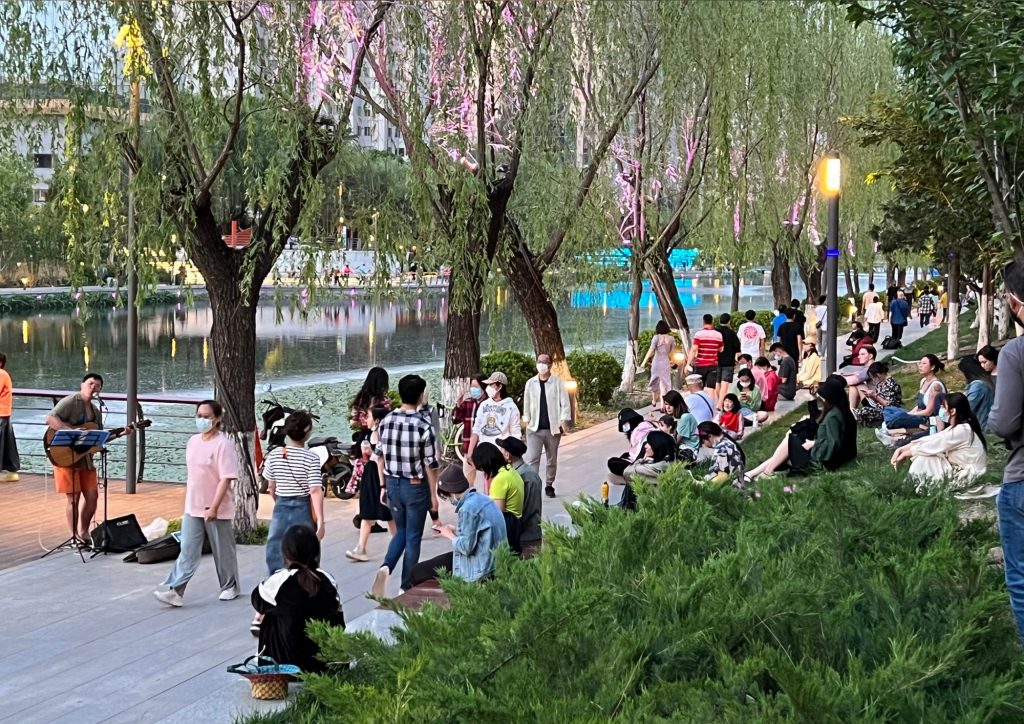
Crowds gather at the Liangma riverfront after restaurants were closed down. These gatherings were effectively forbidden a couple of days later.
Liangmaqiao, Sanlitun, Beijing
Under the shadow of the ongoing Shanghai outbreak response, the occasion that merited this celebration (and the requisite cacophony of COVID-19 prevention policies) was the 70th birthday of the China Council for the Promotion of International Trade (CCPIT). CCPIT was CCBC’s original sponsor here in China when we established our first China office in February 1981, three years after the Council was founded. CCPIT and CCBC have had a long and storied partnership since then, co-hosting dozens of events and forums that have featured many of Canada and China’s most senior leaders, including a luncheon in Montreal a few years ago for Premier LI himself. CCPIT occupies an interesting role in the organizational chart of the Chinese administration, acting as an economic bridge for China to engage foreign business communities worldwide. The state-run agency also boasts a newly minted Chairman in Mr. REN Hongbin, with a deep background in the Ministry of Commerce and diplomatic postings. In his few short months at the helm, he seems to have reinvigorated CCPIT, culminating in this large-scale event featuring some of China’s largest looming figures.
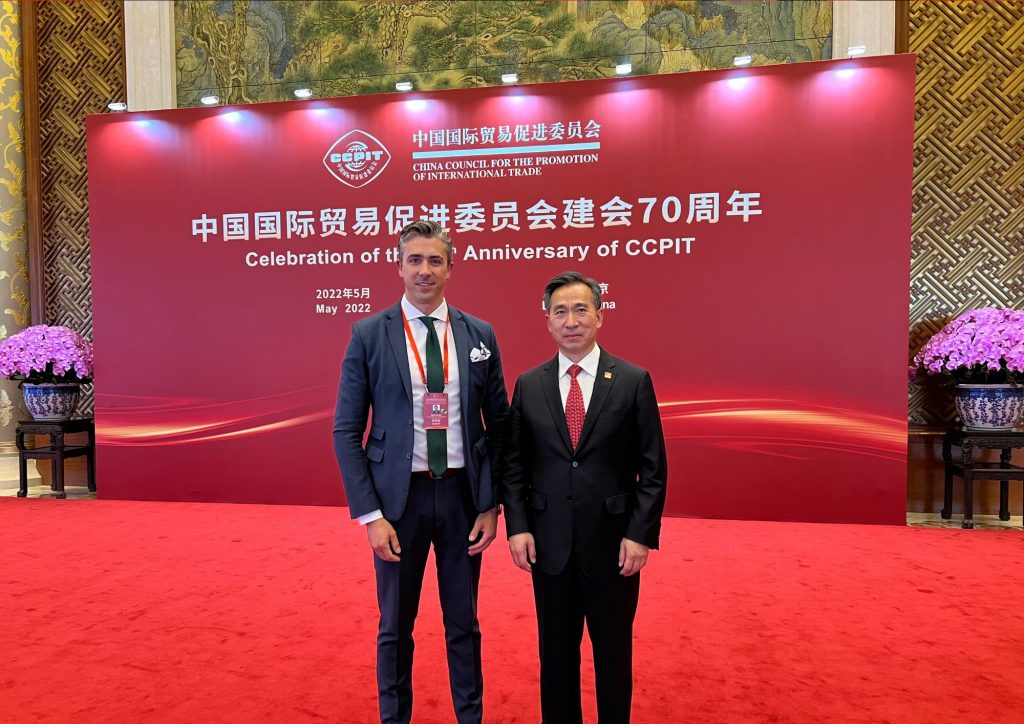
CCBC Managing Director China Noah Fraser and CCPIT Chairman REN Hongbin, Diaoyutai
In order to pass the COVID-19 protocols required to enter the Diaoyutai closed loop and come within a few feet of the Premier, to say nothing of Vice-Premier HU Chunhua and other senior officials, CCPIT delivered a fairly strict criteria: three jabs of Sinovac, no travel outside of Beijing for 30 days, daily COVID-19 tests for the three days leading up to the event, and no entry to any venues other than my home or office for 12 days leading up to the event. Under the Beijing “lockdown-lite” regime, this wasn’t really too much to ask. Coffee shops, bars and restaurants are only open for takeaway (which led to a few streetside and riverside block parties which were quickly outlawed), gyms are closed, and our Beijing office location had a “close-contact” scare in the adjacent residence, so we were unable to enter the building for most of that time anyway. A call to the international hospital with an explanation of my upcoming meeting with the Premier allowed me to skirt the five-week wait list for my Sinovac booster – I was given an “emergency appointment” for the following morning. Despite my complaints, we have been managing to escape the worst features of lockdown here in Beijing as we can still walk freely around the city, but I say that only by employing the benchmark of Shanghai’s experience – we now have CCBC members and staff who have been in their apartments and compounds for more than 60 days at the time of this writing. While reduced access to food was a short-lived issue, the toll of two months of virtually zero activity on both the citizens and the city – to say nothing of the threat of centralized quarantine – is going to leave permanent scars. More on that in a future Dispatch.
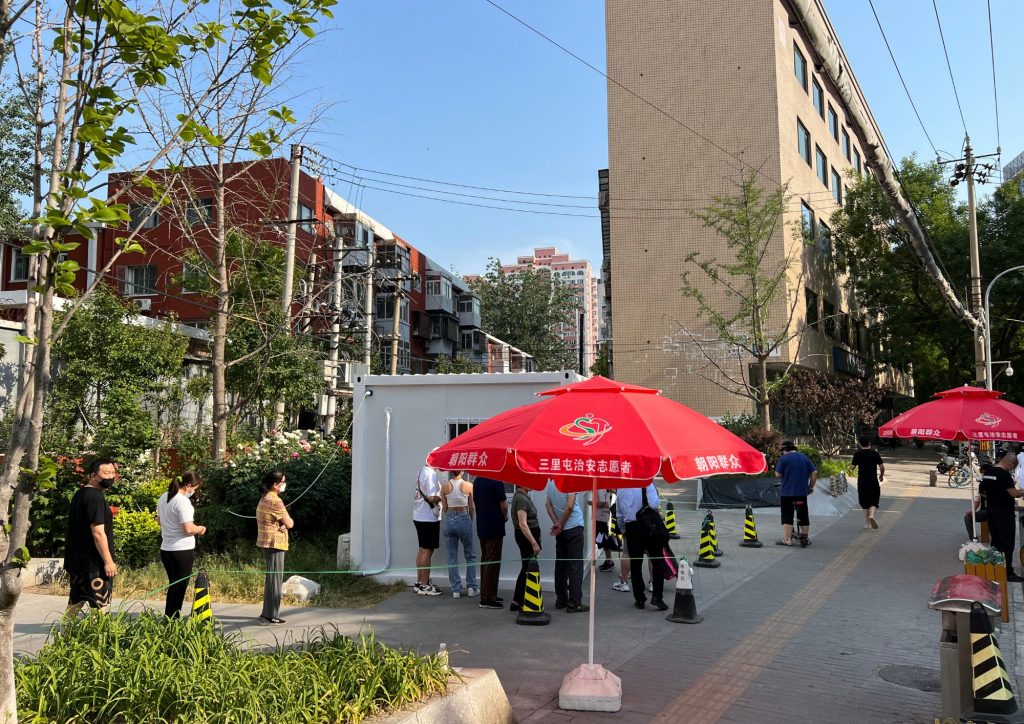
COVID-19 community testing facilities have evolved from makeshift streetside tables and chairs to much more permanent fixtures.
Sanlitun, Beijing
For the non-China watcher, the Diaoyutai State Guesthouse is essentially sacred ground in the capital. A collection of villas occupying a massive park in western Beijing, Diaoyutai has been the official venue for hosting foreign dignitaries since China’s early opening up, now many decades past. The late Right Hon. Prime Minister Pierre Elliott Trudeau stayed there on his trip to Beijing after establishing diplomatic relations with the People’s Republic of China, along with President Nixon and countless other global heads of state and “big potatoes.” Each villa serves as a small, five-star hotel – we stayed a stone’s throw from the legendary Villa #18 (home of the ultra-VIPs, Trudeau, Nixon et al) in Villa #2, where many late nights were spent by their staff negotiating the minutiae of joint statements, taking delegation meals and pacing halls adorned with art and veritable treasures from the Tang, Ming and Qing dynasties. Many of the treasures and art were relocated from their former home at the Forbidden City, back when Diaoyutai opened in the 1950s. The complex is several kilometres square and features some major event venues to host large-scale engagements. There could be no more appropriate venue in the country for the 70th anniversary symposium for China’s foreign trade and investment promotion organization.
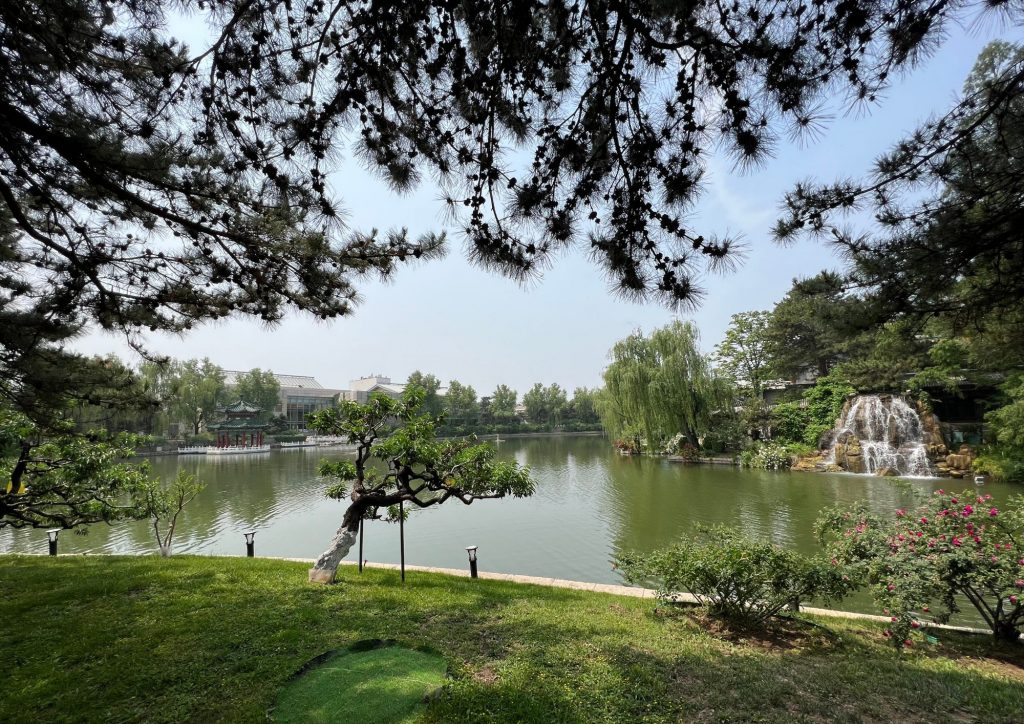
The lake at the rear of Villa #18, Diaoyutai State Guesthouse.
The Diaoyutai experience took place over roughly 24 hours, with the first evening of the two-night forum acting as a larger-scale, more public event with roughly 200 in attendance. The heads of most G20 national chambers of commerce and business councils, CEOs of large-scale foreign invested companies, elder statesman CCPIT/Commerce leaders and plenty of state media rounded out the group. Frontpage news the following day across the country was the video address from President XI Jinping. The President made an emphatic, four-point speech with an overarching message of “tearing down walls:” that China will continue to open up its markets, liberalize its regulatory environment, and create an international-standard investment landscape – all positions that CCBC vigorously supports. A few highlights of the evening were bumping into our friend Vice Minister of Commerce WANG Shouwen during the networking session (who has spoken at our last two AGMs) and speaking with Chairman REN at the end of the evening to congratulate him on his new role and discuss international travel restrictions.
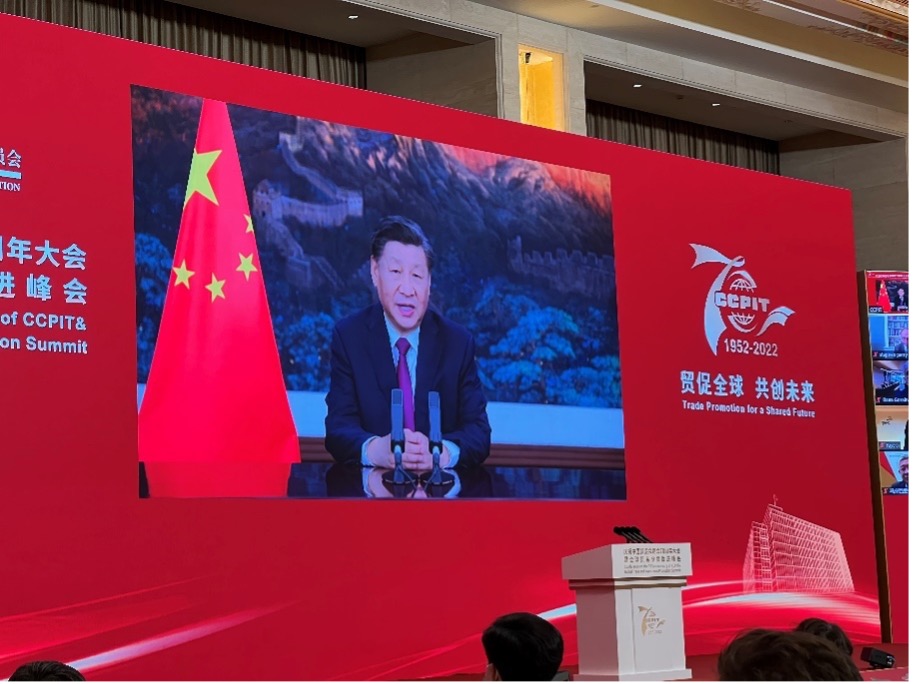
President XI Jinping addresses the CCPIT 70th Anniversary forum.
The following morning kicked off with an obligatory COVID-19 test at 8:00 am in the villa foyer, prior to entering in-room quarantine for the rest of the day while awaiting the results of the scrape. Bento box-style meals were delivered during the day (which were excellent, I might add), as the chants of soldiers running drills in the neighbouring military compound punctuated the hours. At about 5:30 pm, CCPIT staff checked in to see our morning test results, automatically appearing in the Beijing city-level WeChat-based “Health Kit” mini-program, which collects all your local travel info (essentially every business, taxi or venue you have entered since the onset of the pandemic), compiles previous test results, and logs vaccinations. With the “all clear,” the roughly 15 foreign guests boarded the closed-loop bus and cruised through idyllic Diaoyutai to meet with the Premier.
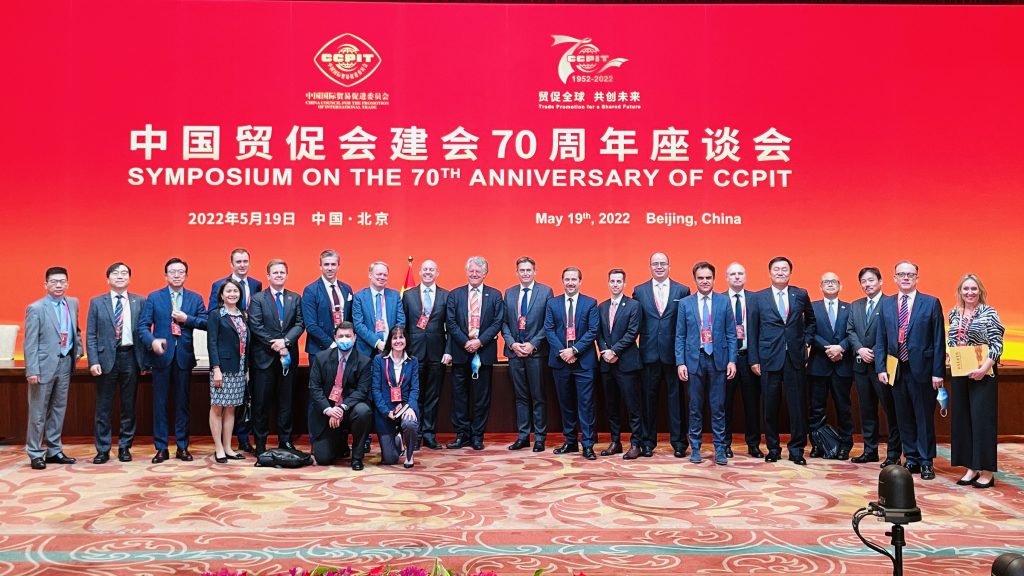
Business association and corporate leaders, Fanghua Villa, Diaoyutai.
The symposium on night two was hosted by Chairman REN, who sat alongside some of China’s highest-level government officials dealing with trade and investment – Vice Premier HU Chunhua, State Council Secretary-General XIAO Jie, and National Development and Reform Commission Minister HE Lifeng. Roughly three dozen senior ministers, vice-ministers and director-general level cadres sat across from us. After the Premier was welcomed with a standing ovation (which had been preceded by about five long minutes of dead silence), the first 90 minutes of the agenda featured speeches from several business organizations representing some of China’s largest and most valued trading partners. Messages of congratulations on the 70-year milestone were interspersed with requests for improved management of the Shanghai lockdown, market access reforms, re-integration with the global economy, and reduced travel restrictions, to name a few. The Premier sat attentively, listening closely to each presentation, and took no notes. When called upon to offer closing remarks to the group, he proved that no notes were necessary, and proceeded to craft a 30-minute long extemporaneous response, eloquently addressing virtually every point that was shared.
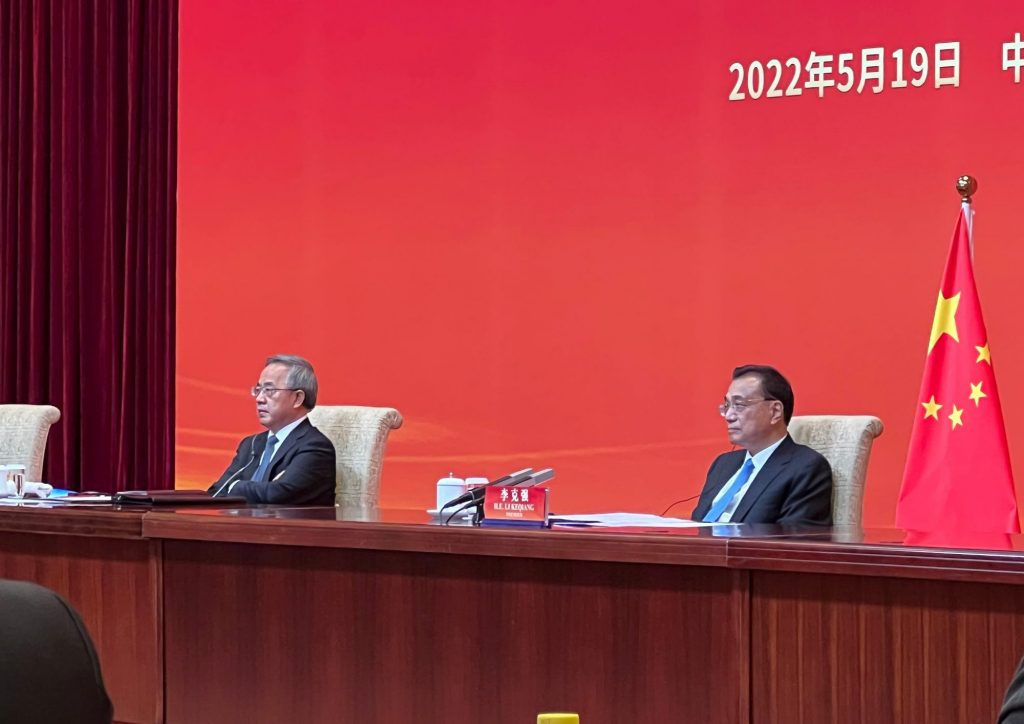
Vice Premier HU Chunhua and Premier LI Keqiang, Fanghua Villa, Diaoyutai.
Premier LI began by thanking the business community for everything that we have done for China since Reform and Opening, with some of the organizations’ activities even having preceded diplomatic relations. He remarked on how, in this time of profound geopolitical change, trade has never been more important to help solve global challenges. He encouraged continued trust in China as an investment destination, characterizing it as a wise choice with strong long-term promise, especially in the sectors of manufacturing, agriculture, and services. He reminded the group that while GDP is growing, per capita GDP in China is still in line with that of a developing country pursuing modernization, and they look to multilateral organizations like the WTO for guidance. He reiterated the importance of two-way trade as a vehicle for peace and sustainability, but also that trade will always have compromises, and twists and turns along the way. He empathized with business leaders facing challenges with COVID-19 policies in China, and he willed us to convey to our business communities at home to pull together with China and have faith. In the meantime, we should come up with specific lists of what we need, and he has mandated CCPIT to assemble a special task force to deal with these concerns directly. He confirmed China’s goal to continue to create and improve a world-class investment environment – admitting its imperfection, but imploring us to relay our issues, believe in the dynamics of trade, and that he looks forward to our continued identification of China as a destination to work and invest.
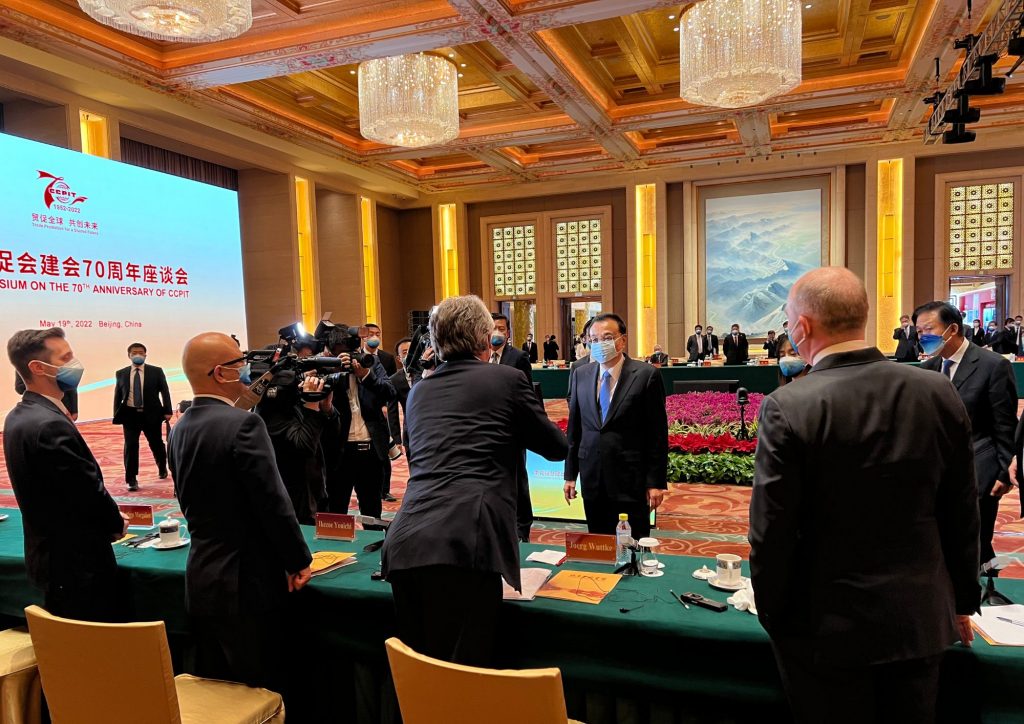
Premier LI Keqiang greets foreign business association delegates, Fanghua Villa, Diaoyutai.
While awaiting the closed loop bus out of Diaoyutai, leaders of the Councils and Chambers reflected on how dozens (if not hundreds) of our members over the past several months have expressed their challenges to us, most of which are not unique, especially since the augmented severity of zero-COVID policies in Shanghai; and now, increasingly, Beijing. These relationships with organizations like CCPIT, cultivated over the past 40+ years here at CCBC, are invested in for our communal benefit and for better business. If you are experiencing issues, it is more important than ever to share them with us directly, and these lines of communication into the top decision-making bodies of the Chinese government can be activated for your advantage as members.
As always, please get in touch with me here in Beijing, China.
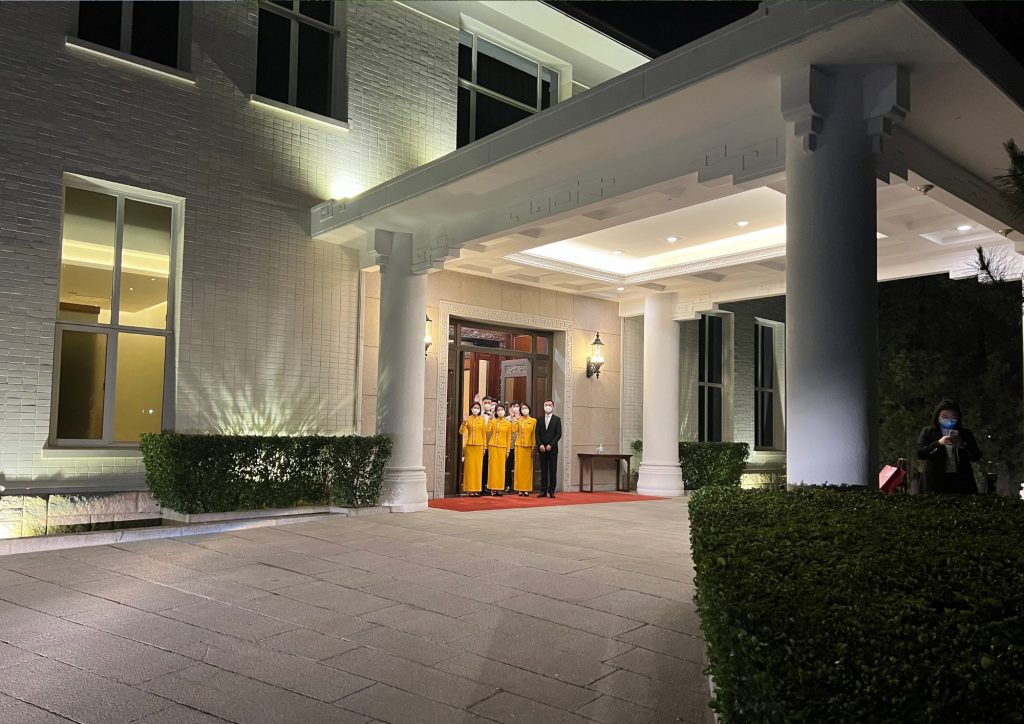
Departing Villa #2, Diaoyutai State Guesthouse.