
Beijing Dispatch #18 – Ringing in the Spring with the Big White Tiger
Beijing Dispatch #18 – Ringing in the Spring with the Big White Tiger
 Here in chilly Beijing, we recently underwent the annual Spring Festival shutdown tradition and celebrated the beginning of the Year of the Tiger, which I admittedly found pretty underwhelming in its inconvenience when compared to previous years. With COVID cases still proliferating around the country and the “dynamic zero” strategy in full effect alongside the Olympic kickoff, we saw a hugely reduced outflux of people and long-term business closures this year in the Capital. It wasn’t strictly by choice – most residents were advised to stay firmly in place. Concern about outbreaks is serious – heaven forbid the infamous “Big White” (or 大白) will descend upon your business or residential complex when a suspected case is discovered – a swirling cloud of dozens of COVID testing team members, all clad in snow-white, head-to-toe hazmat suits arrive to set up shop and run the COVID testing gamut on everyone in sight.
Connections here reported being forced to do between three and eight COVID tests over the course of the holiday week inside their residential compounds. Depending on their city district, some would wait outside in sub-zero temperatures for several hours to dutifully have their throats scraped in batch-testing format – with the total number of tests administered somewhere in the realm of millions per day. While this may sound like overkill, something must be going right: I have now been inside Mainland China for over 26 straight months, and I have not personally met one individual who has encountered, much less contracted, COVID-19 in the Middle Kingdom.
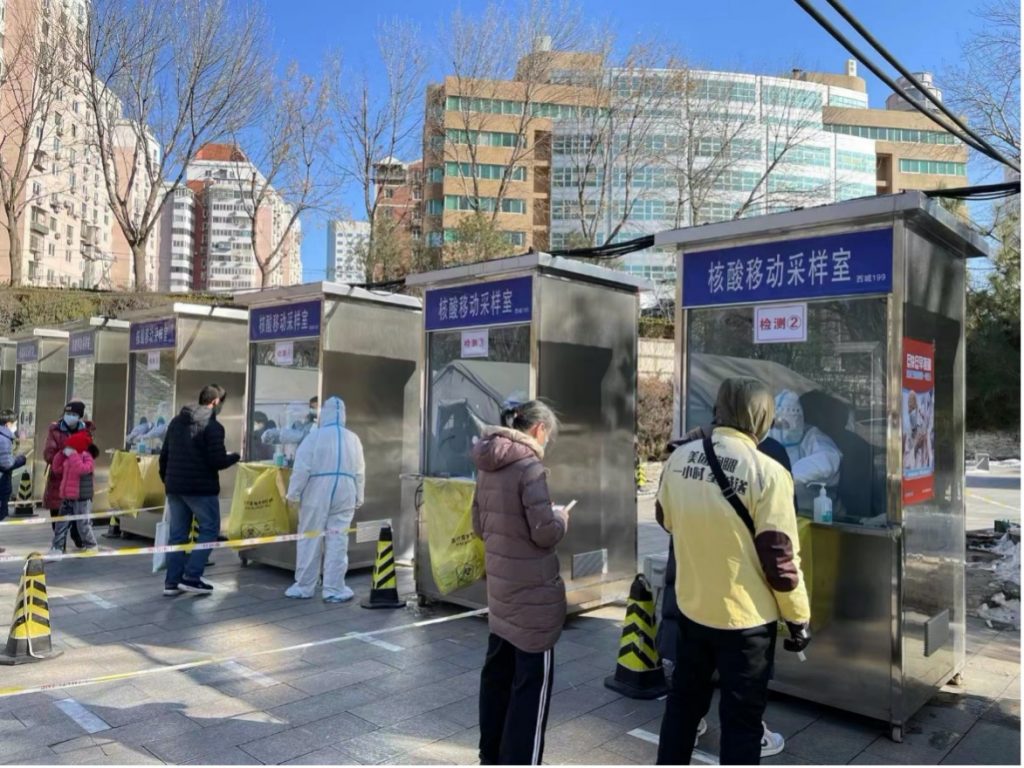
Temporary testing facilities in residential compound, Xicheng District, Beijing.
Spring Festival 2022
We certainly maintain some significant concerns with the onset of Omicron in China. The behaviour of this variant was particularly worrying in areas beyond major contact-tracing infrastructure and where the number of ICU beds per capita is exceptionally low, i.e. third-tier cities and beyond into the countryside. Cases began cropping up in early January 2022, and some major cities, such as Xi’an, underwent significant, well-publicized lockdowns not dissimilar to what we experienced here in early 2020.
While the Olympics were overwhelmingly executed in the “closed loop,” organizers have aggressively increased scrutiny on the few potential event attendees coming from the city. I for one had an invitation to attend the Opening Ceremonies, Closing Ceremonies as well as a couple of women’s hockey tournament events – but was ultimately denied entry to all of the above, as I’m still not eligible for the absolutely-critical number three booster shot, which requires a six-month gap after your second jab of the Chinese vaccine. Alas, it’s only been about 120 days since mine! A friend who resides in Beijing’s then-case-riddled (<100 cases) Fengtai district was also taken off the admissibility list, despite not having any exposure and being triple-vaxxed. Those who were lucky enough to attend had to board spray-disinfected buses at a rallying point outside the city centre, provide COVID-negative test results, show triple-vaccinated status, refrain from bringing in outside food and beverages, and submit self-monitored temperature checks and COVID test results for the 72 hours following the event. Funnily enough, being a resident of the host city of the Olympics in 2022 doesn’t really have many benefits or notable differences from being anywhere else in the world, outside of the events being conveniently scheduled for our time zone. Despite a feeling of being segregated from the Games occuring on my own doorstep, I understand and appreciate that the government here sees the now-concluded 2022 Olympics as an absolute win in terms of China’s COVID-19 control systems.

Olympic fans pose in Sanlitun with the now-viral Bing Dwen Dwen – the official Beijing 2022 Mascot.
Spring Festival 2022
In other obscure Canadian Olympic news, one of the aforementioned attendees who met the criteria for admittance to a Canadian women’s tournament hockey game turned up to the event in his game jersey from our local Beijing (beer) International Ice Hockey (BIIH) league. As one of the very few fans in the stands, he was caught on camera with the lovingly-derivative “Beijing Expos” jersey, garnering extreme interest from our friends at Radio-Canada in Quebec. He and his group were tracked down and interviewed, gathering a ton of attention for the fabulously-organized league that has become a permanent fixture in the weekly calendars of many Beijing expats. Several years ago at the inception of the team in the BIIH, the co-captains, who were originally from La Belle Province and wanted to show some pride for the storied (now defunct) baseball franchise, built out the logo from the classic Expos “M.” The interview is largely in French, but it gives a glimpse into the lives of a few of the internationals who remain in Beijing and are living a fairly normal existence and plugging away on their wrist shots. Despite having fewer players to draft than ever, the league is still very competitive with six motley-crew teams assembled from enthusiasts hailing from at least 20 countries.
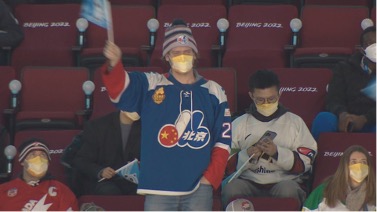
Beijing Expos prospect caught on camera, Wukesong Ice Center.
February 5, 2022

Beijing Expos vs Beijing Bulls (the latter being the proud team of the author).
Shunyi, Beijing – January 2022
It certainly seems from the ground here that the trendline of fewer and fewer expats hitting the ice in China will continue in its current “inverted hockey stick”-shaped decline. Predictions of China relaxing its travel policies after the Olympics appear to have missed the mark. Reactions to small outbreaks have been swift and merciless (owing partially to the equally swift and merciless penalties applied to local officials in areas with cases), and looking to Hong Kong as an example will not inspire much faith in opening up. The peanut-gallery observer consensus here is that we will be living with COVID-zero-esque policies and will not see anything approaching international border relaxation until after the National People’s Congress in late 2022. That is when President Xi is anticipated to ascend to a third term (and potentially a new title), in what will prove to be the end of a calendar year of political drama unlike any seen in a decade ̶ arguably three decades. Mid-2023 may shed some glimmers of light at the end of the tunnel, with other formal positions likely to be assumed by Xi in March of that year, and presumably between now and then the rollout of a domestic mRNA vaccine or some other combination of factors that leads to more clarity.
For now, it is our best guess that anything approaching quarantine-free travel in and out of China will be highly unlikely for another 18-24 months, and quite possibly much longer. It is therefore vitally important for business executives and leaders to keep abreast of what is going on here from home, through our programs like ChinaProxy (our local rental and human resources service packages) or our upcoming events including our US-Canada-China series, our sector-based Five-Year Plan Deep Dives (with the Economist Intelligence Corporate Network), and our Business and ESG Integration in China report (in partnership with PwC and the Cheung Kong Graduate School of Business).
As always, if you have any questions on your business in China, or just want to talk puck, please get in touch with me at noah@ccbc.com.