
Beijing Dispatch #10 – Springing into the Labour Day Holiday with Cautious Optimism
Beijing Dispatch #10 – Springing into the Labour Day Holiday with Cautious Optimism
 This week in Beijing, we wave goodbye to the approximately 10 days of spring we enjoyed as the temperatures are now soaring into the high 30s. Also soaring are spirits, as a couple of key measures of COVID-19 confidence have finally been announced: the “Two Sessions” have been rescheduled, as well as a partial reopening of schools in the capital. In the eyes of many, including the inestimable China-hand Bill Bishop, these markers are two of three indications of China’s path to getting back to normal — the first being President Xi’s visit to Wuhan, which happened several weeks ago. In other positive news, the 14-day mandatory quarantine for those returning to Beijing from “low-risk” areas has been lifted, effectively opening up domestic travel again, just in time for the Labour Day Holiday. DiDi (China’s Uber) coupons and online promotions are flying, and tickets to visit the no-longer-forbidden Forbidden City sold out in mere minutes — for the next six days.
Of the three aforementioned broader-scale indicators, I firmly believe the “Two Sessions” is the more critical, as it represents the most public and closely scrutinized government/Party activity of the year. The May 22nd reschedule date marks a 10-week delay from the original March 5th plan, and readers can be certain that this affair will be as iron-clad as ever. On the other hand, schools “reopening” may be bit of an overstatement — it is generally only the Grade 12 students who are returning in order to write the “Gaokao,” national university entrance exams. Nothing can get in the way of several thousand years of tradition — at least, certainly not a global pandemic.
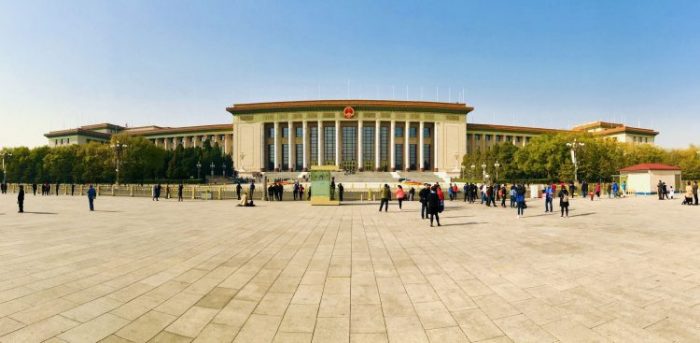
Photo: Noah Fraser, Nov. 2018
If you’re curious about what the “Two Sessions” (or 两会, lianghui) actually is, by definition it is the annual plenary meetings of the National People’s Congress, the PRC’s top legislature, and the Chinese People’s Consultative Conference, a representative group from across China that advises the government. This is a massive political ritual, rife with symbolism and fodder for China-watchers to analyze, where roughly 3,000 CCP members and 2,000 non-Party attendees congregate in China’s Great Hall of the People, on the west side of Tiananmen Square (see above). Many claim it to be a “rubber-stamp” parliament, approving whatever legislation is tabled without rigorous debate, but well-trained eyes always catch signals and surprises in the tea leaves. This year, over a very compressed two days, expect announcements on consumption stimulation policies and continued COVID-19 control efforts. CCBC will be running a webinar after the “Two Sessions” for our members, which will offer insights on the proceedings, but also a more in-depth analysis of Chinese elite politics and the next five-year plan. Keep an eye on our upcoming events.
As for the other indicator, the return of senior students to campus was a welcomed sign, for both local and international schools. Facilities and staff have been sanitizing, stocking up on personal protective equipment (PPE), and even running drills to ensure that flow of people-traffic at doors and washrooms is kept to a bare minimum to increase social distance. The Canadian International School of Beijing shared “back to school” photos on their official WeChat account, and they are eagerly anticipating a date for programming to kick back in for the rest of the student body — see below. While the soon-to-be graduates are back and cramming for final exams, a nagging question persists for Canadian (and global) universities: how many international students will really be on campus in Canada in September, and will the institutions even be open to accept them?
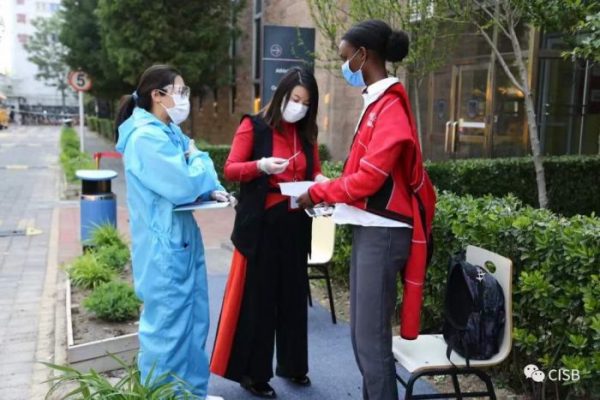
Photo: CISB WeChat
International students represent a massive proportion of Canadian university revenues. Students from China – combined with those from India – are often responsible for over half of a given university’s annual tuition income. Will international students really pay the premium fees to take classes over a remote digital platform? And if so, are Canadian schools prepared to overcome the technical challenges of streaming or uploading exabytes of data into a Chinese mainland server behind the Great Firewall? We would ask that our university members keep us informed of their plans and anticipated fallout from the ongoing COVID-19 challenge. There is possibly no sector in Canada, outside of travel and tourism, that is more directly threatened by the current situation than education, and we are committed to supporting our many organizations in this sector.
In order to continue to support the post-secondary vertical, regardless of what may come in the fall and beyond, CCBC is conducting large-scale online webinars this week and next, where eight Canadian universities are showcasing their programs and campuses to 300+ prospective Chinese students — all entirely online. In this first of two sessions, pictured below, four of these eight leading institutions conveyed their distinct advantages, all in Mandarin, delivered for free over Tencent’s (the company behind WeChat) WeMeet platform. Another example of how these technologies are helping us alleviate the immediate challenges being faced, but only as a stopgap solution to the broader issue for this industry.
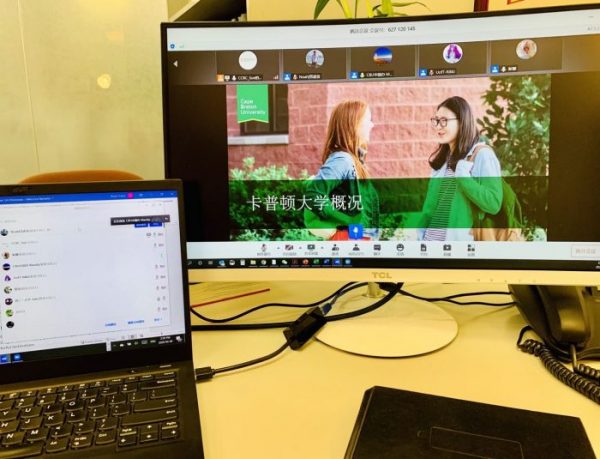
Photo: Noah Fraser, April 2020
Next week, CCBC will also be hosting the China team of Finance Canada, headed up by Dr. Daniel Koldyk, for a live webinar and Q&A session on Exploring China’s Macroeconomy. Livestreaming from inside the Canadian Embassy in Beijing, we will look at big picture indicators, major threats to recovery, and just how far along China really is down the road to full capacity. We’ll be doing two sessions, one geared for those based in Canada, and another for those in China/Asia. As always, myself and Edward Dai in Shanghai are here in the Mainland, behind the “Great Wall,” and are positioned to assist with any issue our members may have while prevented from travelling. Happy Labour Day from China!