
Beijing Dispatch #11 – A Return to the Middle Kingdom? What Stranded Canuck Expats Need to Know
Beijing Dispatch #11 – A Return to the Middle Kingdom? What Stranded Canuck Expats Need to Know
 Sun-drenched restaurant patios full of smiling, unmasked customers may seem like a pipe-dream to those in Canada right now, but with China a couple of months further along the spectrum of re-opening, this is the happy reality on the ground in most of China’s metropolitan areas. Schools are gradually getting back, with reports that grades 4-11 will be in class as of June 1. Traffic is at parking-lot levels on Chang’an Boulevard leading up to the Two Sessions meetings later this week, and by most visual measures (but for those notable exceptions in the Northeastern province of Jilin), China appears to be at full tilt. So, it begs the question: when can the hundreds, if not thousands, of Canadians who call China home return to the Middle Kingdom? What should you make of the reports of the “green lanes” or “fast track” visas for foreigners to gain re-entry? CCBC has been actively collecting information on your behalf, and in some cases, successfully getting our members back into China. This week’s Beijing Dispatch focuses on some key facts and case studies on this tremendously challenging issue for so many displaced expats around the world.
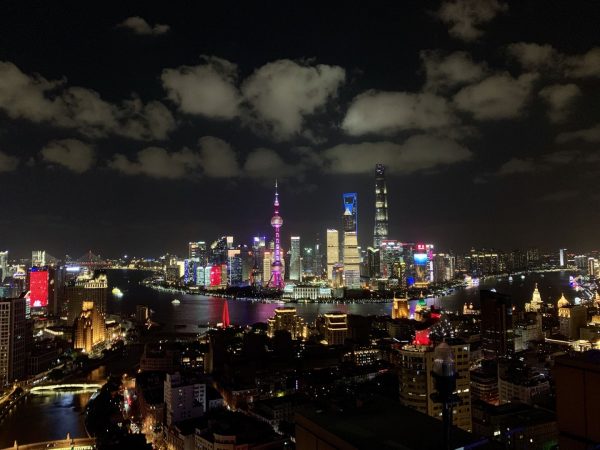
Photo: Noah Fraser, September 2019 – Pudong and the Bund, Shanghai.
Most of our readers are aware that China largely closed its doors as of March 28. Those who managed to get back in ahead of the deadline were subjected to a two-week quarantine period inside a government-assigned hotel, via a municipal sorting facility. There were some exceptions to the hard-and-fast rule, as well as differing reports on access to services and quality of lodgings, but that difficult time is a quickly-fading memory now that those returnees are freely moving about domestic China and have the comforts of a broadly re-opened consumer economy. Fast forward to four days ago, when the Global Times reported that “Chinese government departments are working with some countries and regions to set up ‘express access’ channels for the entry of personnel of foreign-invested enterprises amid the virus outbreak,” according to MOFCOM. This news, while exciting, is obviously opaque at first glance, and operative wording like “some countries” certainly jumps out. So, we started to dive in.
From a national perspective, one of the first major examples of a country achieving a deal is the Germans, who enjoy a massive impact on the automotive sector in China, among other industries. About 200 executives, key specialists, and long-separated family members are the target candidates for the first flight, aimed for early next week. Now, the tricky part: the criteria. For your reference and additional colour on the requirements, please see some extracts below from an email that went out to German Chamber members who may want to apply for a return trip on the proposed charter.
Initial Conditions:
- Mandatory COVID-19 test before departure from Germany: Proof of negative test result valid 48 hours before departure issued by company doctor or local health authorities or commercial test providing institutes.
- 48-hour quarantine after arrival in China: Chinese authorities will select a quarantine hotel in Shanghai for a mandatory 48-hour quarantine.
- Mandatory COVID-19 & anti-body test after arrival in China: During quarantine in Shanghai a mandatory COVID-19 and anti-body test will be required by every passenger.
Further Pre-Conditions:
- Approval of passenger list by Chinese provincial authorities and Chinese Ministry of Foreign Affairs.
- Issuing/reinstatement of visa for passengers on an approved passenger list by Chinese embassy and Consulates General in Germany.
Passenger Criteria:
- According to current travel regulations, foreign nationals for necessary economic, trade, scientific or technological activities or out of emergency humanitarian needs may apply for visas at Chinese embassies or consulates.
- Only persons willing to travel back to China within the next 2-3 weeks should be nominated for a tentative passenger charter flight list.
- Employees of German companies in China with valid residence permit.
- In exceptional cases: Urgently needed specialists on project basis.
- In exceptional cases: Families of employees of German companies with valid residence permit in case of special social hardship.
The Chamber further outlines that there are no guarantees of the flight going forward, given a continuously evolving situation on the ground in China. Economy class seats are estimated at EUR2,500. The criteria and costs of the same endeavour with Canadian passengers would be comparable, if not more stringent. Clearly, despite the diligent efforts of the Chamber and Embassy, the process remains onerous and expensive. We at CCBC are pursuing several channels to explore similar solutions, but in the meantime…

Photo: Noah Fraser, May 2020 – The Great Wall of China (Simatai)
Pursuing option two: chasing individual access.
Firstly, despite the reports of these express channels, our communications directly with foreign affairs offices in China resulted in the finding that there do not currently appear to be any official guidelines, regulations, or clear rules from state-level government in terms of getting a new visa to China. However, the foreign affairs office in Shanghai advises the following practice for foreigners who want to enter for “crucial business reasons.”
- Have local staff reach out to district-level government (i.e. Jing’an, Shanghai or Chaoyang, Beijing), including the commerce bureau (商务委员会), the economic and informatics bureau (经济和信息化委员会), the science/technology bureau (科技委员会), or foreign affairs office (外事办). The department(s) that supervise or administer the company are the most likely to offer assistance or guidance. Essentially, that means that each company must reach out to their appropriate local district government office wherein their enterprise is officially registered for assistance.
- If the local government department agrees to vouch for the company’s applicant(s), they in turn require another layer of approval, from their respective district reporting office. Should that request be approved, that district body would officially apply for an invitation letter from the provincial-level foreign affairs office (省级外事办公室). In the case of Shanghai, Beijing, Tianjin and Chongqing, the city itself is considered to be at the provincial level in the government hierarchy. Naturally, applicants will not have any insight or influence on these steps of this internal process.
- There are several required backups for any application, but there is not an officially available list to share here. Additionally, application documents requested by the local district government departments may vary from each other, and the local level government’s mandatory list will also ultimately be superseded by the requirements of the provincial-level office, so there may be further documentation requested. This list of documents is long, and CCBC can offer members further information on creating a robust application.
While this may seem to be complex and an inordinate amount of administrative effort (even by China standards), I am happy to report that this heavy lifting has recently paid off. CCBC’s China team successfully consulted and shepherded a successful application of a Canadian family returning to Shanghai from a large Southeast Asian city. The approved invitation letter for entry visas was sent through to the local consulate, and their documentation will be issued early next week. Applicants should check on the opening hours or availability of the local Chinese consulate where they are located — there have been reports of closures and/or lack of communication from some of these offices. Keep in mind that this individual is a senior executive at an established Canadian company registered in Shanghai, and the local government departments deemed the economic benefit of their return to be worth the potential of a new case in their district — no small feat, from that perspective. Now all that’s left is to book air passage where, of course, dollar costs will be high.
Our newest summer intern here at CCBC Beijing conveniently educated me on the meaning of some new Internet slang this week: “TL:DR” or “too long, didn’t read.” (Case in point?) While the appearance may be the opposite, this post is not intended to dissuade applications. We want you back in China, and we’ve proven there is a path. Members who are pressed to return and are keen to apply through this process are encouraged to connect with myself (noah@ccbc.com) or Edward Dai (edward@ccbc.com.cn) to discuss your first steps, including required documentation or likelihood of acceptance.
We at CCBC very much hope that these travel restrictions are intelligently relaxed, reduced or lifted entirely while still maintaining a safe environment for the local population and those of us Canadians who have remained or have returned. So many Canadian students, teachers, entrepreneurs and business leaders who call China home are stranded abroad at great personal and financial cost, and while China’s recent outbreak-related lockdowns in Jilin province and other cities do not immediately bode well, there are some positive signs. The conclusion of the Two Sessions in a few short days will likely offer some indication on timelines for simplified returns of residence permit holders, several international air carriers are planning to add Chinese cities back into their timetables starting next month, and our Canadian diplomats on the home front have been told they will be able to return to their China postings after June 1. With any luck, our business community will not be far behind.