
Beijing Dispatch #20 – There and (not quite) Back Again – A Tale of Travel in and out of COVID-Zero China in Two Parts
Beijing Dispatch #20 – There and (not quite) Back Again – A Tale of Travel in and out of COVID-Zero China in Two Parts
 Glorious. There is no better way to describe our month of shore leave outside the new hermit kingdom after 34 months behind the bamboo curtain. Packed international flights, open skies and green spaces, faces of family and friends not seen in three years, and not a contact-tracing QR code to be found. Having spent the entirety of the pandemic in Mainland China, I had something akin to reverse culture shock when landing in Canada in late September. As I write this latest Dispatch from the confines of the Jinshan Covid Hospital on the outskirts of Shanghai, after spending several days fighting local authorities as they attempted to separate my partner and our infant son, I can say that home feels very far away indeed.
I’ve long been considered dovish on China, at least when it comes to trade and investment. It’s part of the job, but I do remain bullish on this place in the long term. Done right, it is a prime market for some of Canada’s best exports and services. It has an incredibly sophisticated production ecosystem and logistics network, and knocks out major country-level projects like no one else. However, speaking of major country-level projects, it was somewhere around three minutes after deplaning at the once-vibrant Pudong Airport in Shanghai that I began to understand the gravity of how a COVID-zero policy has transformed this country. Little did I know, I was soon going to get a much more comprehensive understanding of what can go wrong under this zero-tolerance regime, and my journey is still far from over.
A little bit of background on COVID-zero. The Chinese population in rural areas, especially the elderly, have very low rates of vaccination. There are various explanations for this, including a trust factor and a circular, perceived lack of necessity — since there is no COVID, one does not require a vaccine, hence zero COVID must be maintained, and so on. Combine this with a low-per-capita ICU bed capacity outside of the tier-one cities like Beijing and Shanghai, and you have extremely high risk of large-scale infection and death. If you consider that the COVID-zero policy is protecting the lives of millions at the cost of some medium-term economic growth and inconvenience to the top earners in the country and you have a basic understanding of Party thinking, you can understand why policy makers are sticking to aggressive lockdowns, contact tracing and mass testing. This is of course a simplified take, but it provides context – if not solace – for the treatment that one ends up receiving on arrival.
While the details and pitfalls I will illustrate in this post are not pretty, the message here is certainly not to advise against my fellow expats to leave China if they can avoid it. The point of these Dispatch articles is to provide some perspective of what is happening here for those not in China, and perhaps a cautionary tale of the worst-case scenario for the executives eager to make their return. I also want to paint the picture from the inside, and share the incredible efforts being made by the individuals executing on this titanic, yet unsustainable, policy. Here’s my story.
My partner, our Beijing-born one-year-old son and I landed in Shanghai on an auspicious Halloween morning, the 31st of October. After four weeks all over Canada and the UK, we were exhausted from our first trip outside China since late 2019. Part of that exhaustion stemmed from the preparation for our return journey which, at a bare minimum, included a flight from Ottawa to Toronto and a stopover in Seoul for a crew change en route to Pudong, rounding out the whole trip at roughly 20 hours. With the ultimate destination of Beijing, we were still a 10-day government mandated hotel stay away from attempting the domestic trip. More on that in Part II of this blog post…
Firstly, flights to China today from Canada (and globally) are very limited. Air Canada once flew daily from Toronto to Beijing, Shanghai and Hong Kong, routes all mirrored in Vancouver. Today, you can’t fly directly to Beijing from Canada (government restrictions on direct flights into the capital), and the Shanghai route takes off only twice a week. In fact, the international flight board at Shanghai Pudong International Airport (PVG) is incredibly light — there were precisely three other outside departures in total on the day we left China, going to Manchester, Seoul, and Hong Kong. This explains how a country that had 95 million international visitors in 2019 barely hosted 1.5 million in 2021. The other element of this scarcity is the astronomical costs to fly; at one point, I saw that business class seats on our flight were priced at about C$13,000 each.
Boarding the flight that we secured required a handful of pre-departure requirements. My partner and I, but not our baby (this comes into play later), had to pass two PCR tests, one 48 hours and one 24 hours before departure. The tests had to be taken at pre-determined clinics, and cost C$310 per person per set. You won’t be surprised to hear that the clinics are Chinese-owned and -operated, but I suspect this has more to do with the communication requirements than a cash-grab – 99% of the passengers on our flight appeared to be Chinese nationals. The nurses were kind, but all business – there was a lineup of travelers in the clinic awaiting their turn for a nasopharyngeal scrape that was akin to a frontal lobotomy.
Once your test results are emailed to you (the second set arrives in the wee hours of the morning of your flight), you are required to upload them, along with several other travel documents, into what I would generously describe as a clunky web portal. If your information is deemed satisfactory, the Chinese Embassy or Consulate in your region will issue you a QR code a few hours later, which you’ll have to provide at airport check-in. In our experience, the codes took about 13 hours to be generated and were received two hours before we had to leave for the airport. The grey hairs had already begun to multiply. The wildly frustrating part of all this was, that after landing in China and clearing the hoops on the other side, and despite all the stress, lost sleep and costs involved in getting the codes, I realized no one had ever actually asked to see them.
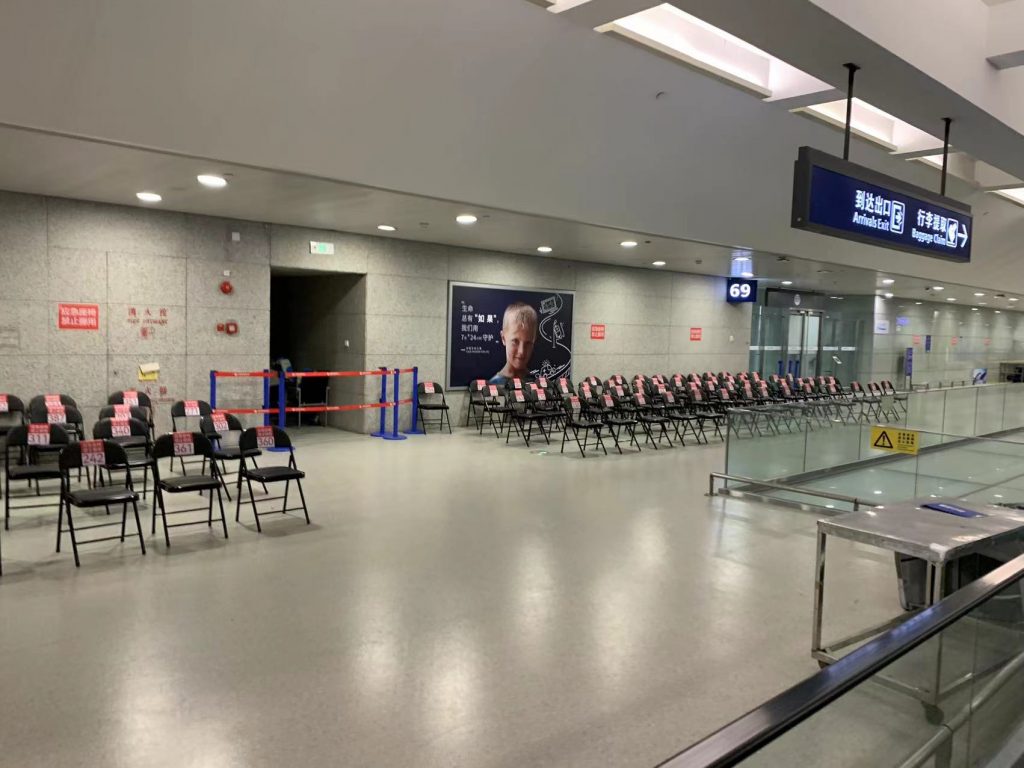
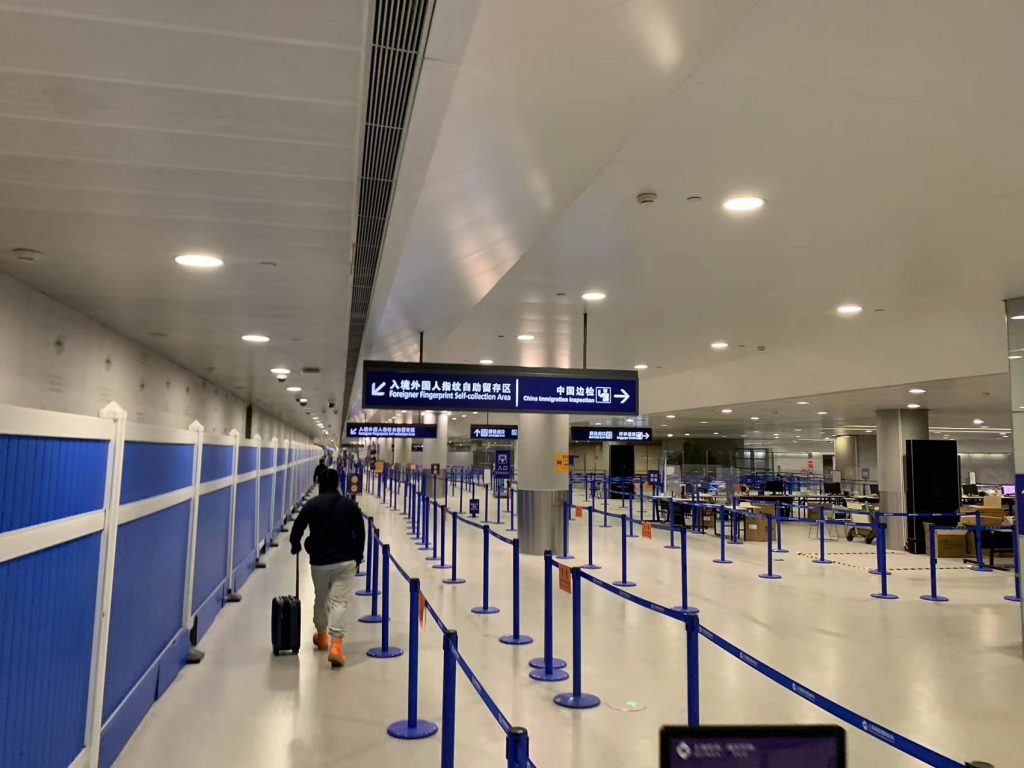
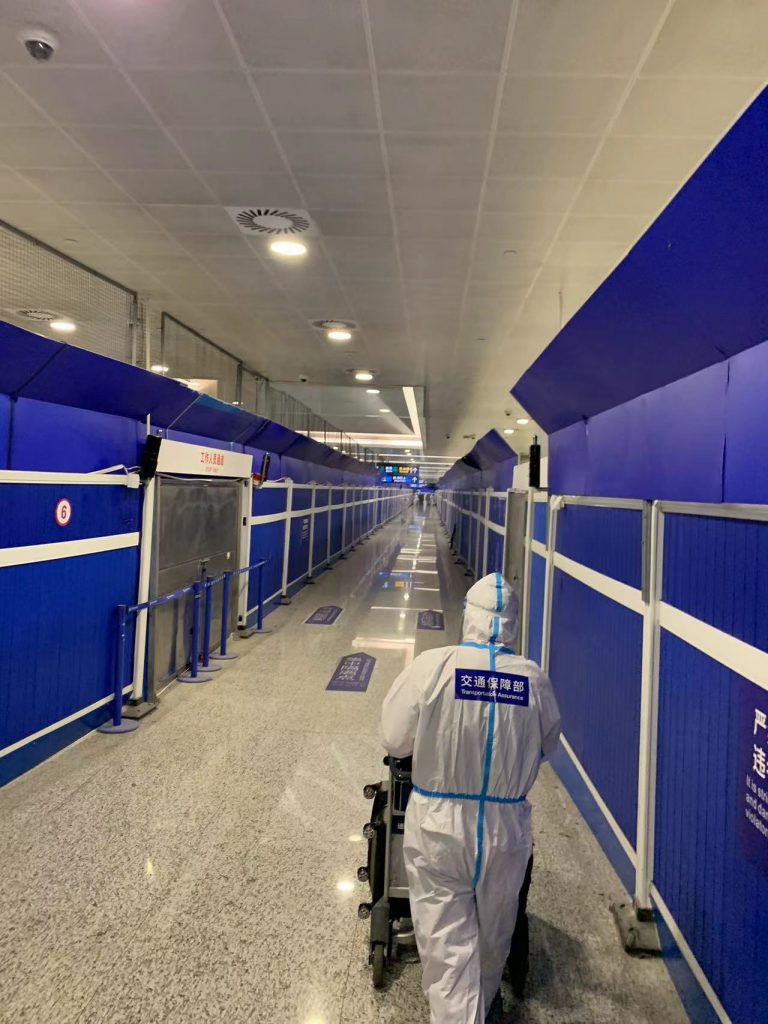
Upon arrival in Shanghai, we were greeted by what might be described as a post-zombie-apocalypse movie set in the airport. Windows, walkways and escalators were all covered by makeshift corrugated tin walls or caution tape. Workers and customs officials all completely mummified in hazmat suits. All modern infrastructure, like biometric fingerprint scanners and express lane scanners, were wrapped in plastic and were caked with dried-out disinfectant spray. Intensive crowd control and social distancing measures had been put into place, but were basically all completely deserted, as arriving flights are steeply staggered and very few travelers are allowed into the airport at once — only one luggage conveyor was active out of 34.
Once an obligatory nasopharyngeal PCR test was administered to both adults and the one-year-old, customs was cleared and luggage was collected, we were herded into waiting areas to be sent to our quarantine hotels. I’d hoped somewhere around this point we may find a channel to make requests, like a hotel that would allow for our family of three to stay together (generally not permitted), or perhaps accept outside deliveries of essentials. Sadly this was not to be, and the only question that was asked was our ultimate destination – answering “Beijing,” we were steered to the left. Our passports were collected and a group of about 20 were loaded onto a small bus, unaware still of where we were being taken. The complete lack of communication, for me anyway, was one of the most surprising and alarming elements of the experience. Everything was carried out in an extremely practiced, militaristic fashion by the white hazmat-suited workers.
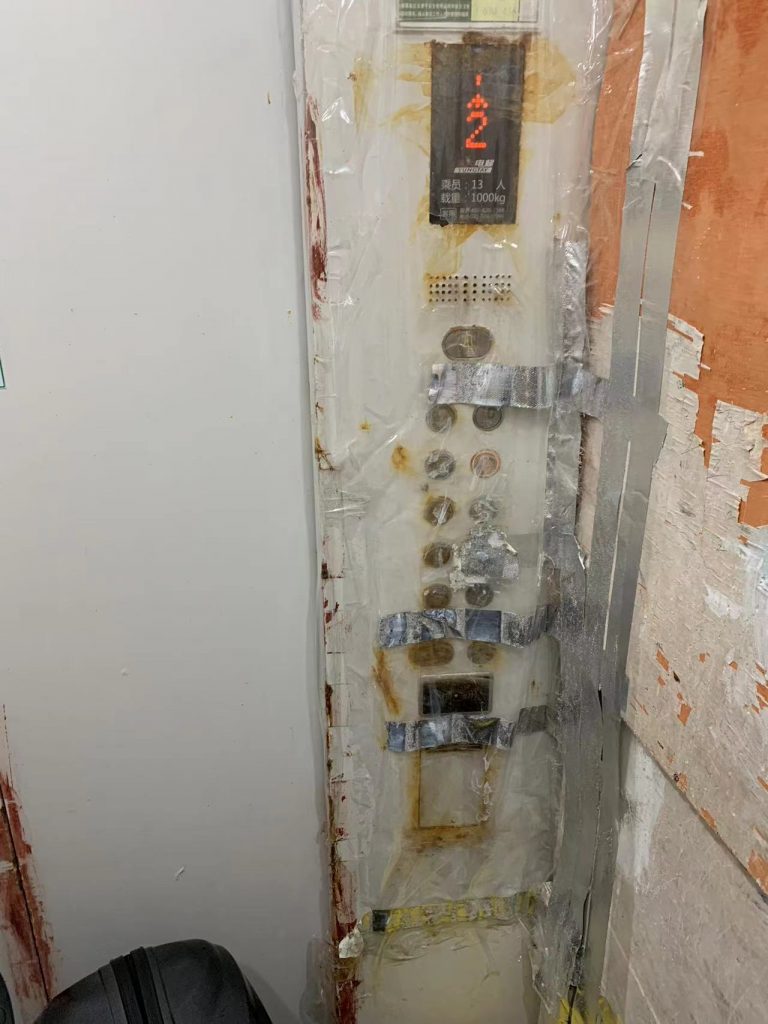
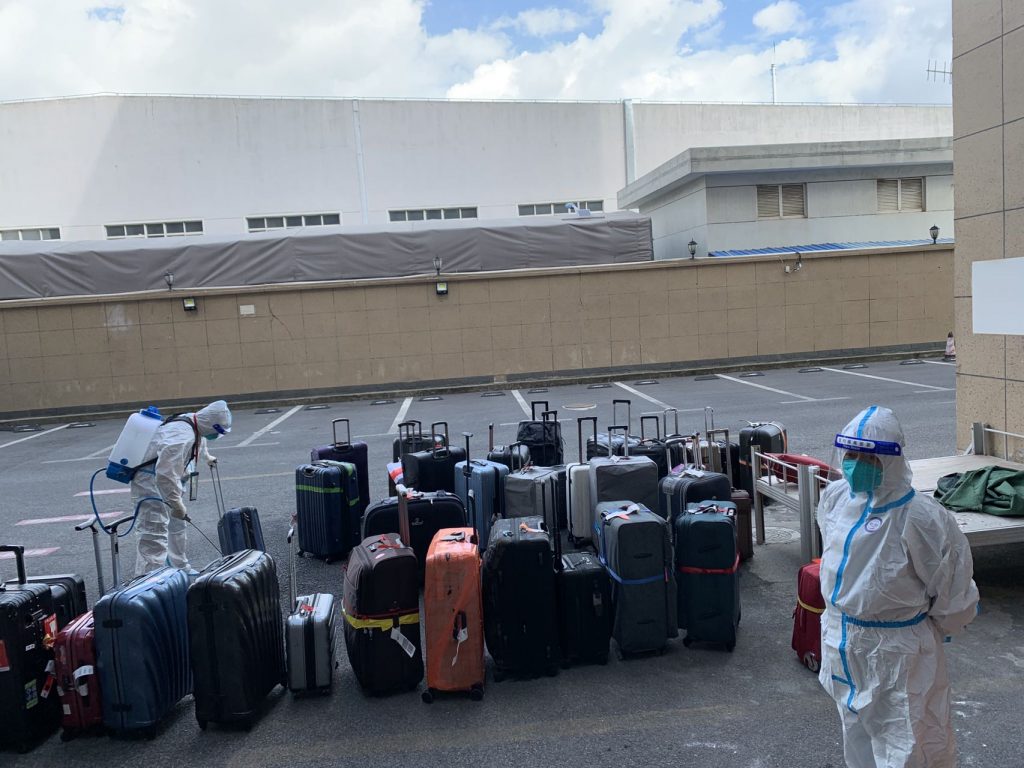
The bus ride to the quarantine hotel was increasingly disheartening the further we got from central Shanghai. Roughly two hours after boarding, we arrived at a dilapidated mid-rise complex in a rural industrial park, inappropriately named the “Vienna International Hotel.” The welcome at this aging, demolition-bound relic was sadly no warmer than that of the airport. We were brought to the back service entrance, where a semi-outdoor, makeshift check-in area had been assembled out of two small portables. Guests line up and fill out an all-Chinese language form while their luggage is doused with aerosol disinfectant to the point of soaking. After a brief but fortunately successful battle with the beleaguered staff, we managed to secure a family suite and my partner, son and I were permitted to spend the 10-day isolation period as a family. Hospitality was payable in advance at roughly C$2,000. Given that the elevator button panel was so rusted out we couldn’t read the numbers and the plastic-coated hallway carpets crunched from the constant bleaching, perhaps we overpaid — especially considering our non-refundable stay at the Vienna was about to be cut very short.
This is where my experience begins to differ from most travelers who have faced the gauntlet of returning to China, and the start of a dive into the uglier side of the risks associated with travel into the country. While those 14 days were grueling, in a way it’s fortunate it happened to me so I can share this story with our members, offer some learning, and we can come away from this with a story that, many many years from now, we’ll be able to laugh about. Stay tuned for Part II, where we fight a district government that attempted to separate a mother from a baby, and experience a Chinese COVID hospital from the inside.