
Beijing Dispatch #13 – Lessons from Riding the “Second Wave”
Beijing Dispatch #13 – Lessons from Riding the “Second Wave”
 The so-called “second wave” in Beijing appears to be behind us, with zero new infections reported over the last three days, and over 10 million COVID-19 tests administered across the city over the last several weeks (yes, you read that right). The district surrounding the Xinfadi wet market area of Beijing – the nucleus of the outbreak – is still considered a “high-risk” zone, yet most other areas of the city have been brought back down to their previous levels. This means that most of us are once again free to travel domestically without proof of COVID-negative status – though it’s still highly recommended, as you may be required to present one in your destination city or when boarding your train. Now that things are inching back towards early-June levels of “normality,” what are some takeaways from this seemingly isolated flare-up that made global headlines and brought the capital back to earth?
When the cases began to spike, it was difficult not to feel concerned – primarily due to the source of the infections. The Xinfadi market, while located far from Beijing’s city centre, acts as a wholesale market and distribution centre for a vast majority of the city’s restaurants and stores, and is the largest of its kind in Asia. It’s difficult to overstate the size and volume of this place in relatable terms; the best comparison I’ve heard is that the market boasts 1.5 times the physical footprint of the gargantuan Forbidden City complex (pictured below). A worse origin for an outbreak is difficult to imagine – perhaps only the water supply would affect more residents.
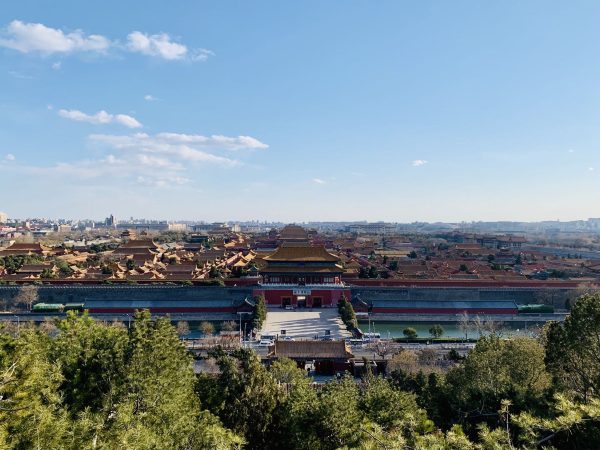
(Photo: Noah Fraser – March 1, 2020)
As one might imagine, restaurants across Beijing took swift action. Every employee had to get tested, with many receiving the call to execute these tests in the middle of the night. Many restaurants and bars remain closed to this day, some inexplicably, with no guidance on when they will be allowed to reopen (to my dismay, this includes my beloved “local,” the half-Canadian Jing-A). Again, the food and beverage industry continues to bear the brunt of this pandemic: an accounting firm that delivered a presentation to CCBC’s Chapter Directors this week commented that the majority of their SME work these days is the liquidation and closure of F&B/entertainment sector WFOEs.
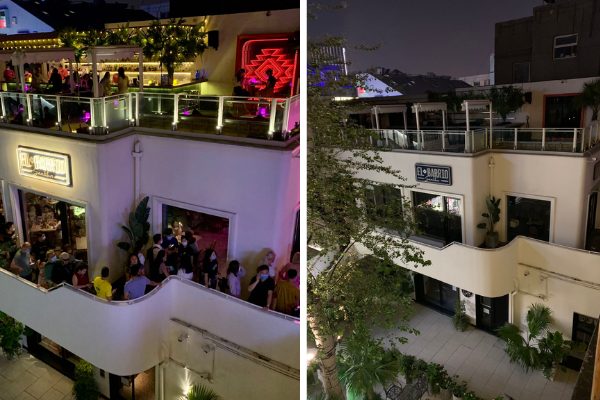
Photo: Noah Fraser – May 28, 2020 vs. June 18, 2020
What a difference a few weeks can make.
So, how has this second wave been instructive? Firstly, it has dulled my already-waning optimism of borders re-opening within the next six months. The economic blow of a new outbreak, in Beijing or anywhere else, is too high, and the liability carried by a given official too great to be worth risking new “imported cases.” You will all have read that the accused culprit of this new outcropping was imported Scandinavian salmon – which is ostensibly possible – but the key word here is imported, a delineation that is made whenever a new case is announced. Remember that inbound travel is only for Chinese nationals (an extremely small fraction of inbound travelers are foreign nationals), so this definition includes any returning individual being infected abroad and returning to China with the virus. More and more flights seem to be getting cancelled (Air Canada’s schedule to China for the month of August was recently slashed), and while there are success stories of green lanes opening up and certain individuals and families returning, there seems to be less and less likelihood that we will see anything resembling open, cross-border travel before 2021. Watch for isolated loosening of policy, such as certain exceptions that might include Hong Kong, which of course as of July 1, is far more connected to the Mainland than ever before. More on that in a future Dispatch.
Secondly, the status quo in terms of observation and control will be maintained indefinitely. Any resident of Beijing and most other cities in China will continue to be required to show their “Health Kit” app (or whatever measure of contact tracing application has been implemented) when entering public areas, such as office buildings, malls, restaurants and more. These applications trace your location over the previous 14 days, in coordination with your mobile service provider. The frequency of the checks will certainly subside as the risk perception ebbs, but there is little chance that these apps will ever be done away with entirely. Infrared temperature checks at community checkpoints will abate (many are already no more than a wave of the thermometer), but I doubt the “bao an” (保安) security guard presence will disappear anytime soon. There are still many business implications to come as well, with most of the year’s fiscal stimulus already dispersed and many months of uncertainty remaining.
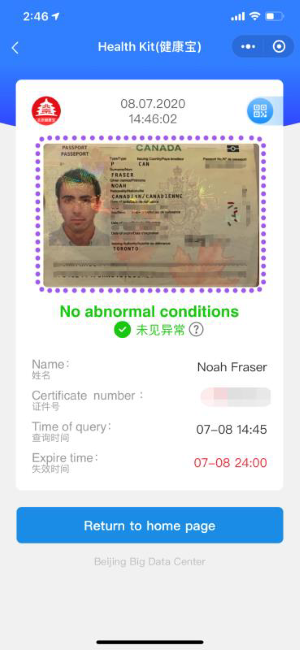
Screenshot of my Beijing “Health Kit” – July 8, 2020
Finally, I firmly believe that we residents of China are going to need to get used to this happening again, and be ready for policies on future outbreaks. The West is still grappling with the slow burn of the first wave, but with China having an extended period of virtually no new reported cases and things seemingly getting back on track, the populace got very used to the idea of being COVID-19-free ahead of this small, but highly impactful, surge. Chaoyang District, one of Beijing’s largest and most populated districts (home of Sanlitun, CBD and dozens of Embassies) had gone nearly two months without a single new infection. While I hope to be proven wrong, if it happened once, it can most certainly happen again. This comparatively fledgling second wave proved how sensitive the government is to even a handful of new infections through its fast and heavy shutdowns, while abroad we see thousands of new cases a day – and very few comparable control measures being implemented. Those in China who are planning business travel, vacations, in-person events and any activities that could fall under the category of a social gathering should have a plan B… and probably C. While this all may sound grim, we need to keep these scenarios in mind as very plausible – if not probable – and prepare accordingly.
In the wake of the scare of these new cases, we unfortunately had to postpone our Canada Day Garden Cocktails and Dinner with Ambassador Barton to later this summer, on which we will keep you apprised. Despite the delay on the bigger annual dinner, we went ahead with a smaller and more subdued Canada Day week in Beijing, with a golf tournament, patio drinks at a local Canadian-owned bar, capped off with a rooftop networking evening with the Australian Chamber of Commerce. In the face of a very challenging couple of weeks in bilateral relations, some degree of continuity persists here in the Canadian community, and I urge our citizens who are trying to get back to China to please contact myself here in Beijing, or Edward Dai in our Shanghai office, for guidance on your file. Our stable of upcoming virtual events remains robust, starting with a cross-Canada meeting/Q&A session next week with China’s Ambassador to Canada CONG Peiwu. To register for the Ambassador CONG Peiwu session or to learn more about our other upcoming virtual events, please visit CCBC.com.